
See your office processes,
find the waiting, streamline the flow
MAKI GAMI maps the flow of documents, information and approvals step by step on a swimlane map, records each step's time, problem and improvement idea, and calculates PCE and the number of handoffs instantly. The team works together on the same map; AI assesses the office wastes.
In the office, it is the waiting that grows, not the work
MAKI GAMI keeps the office process on a digital, lasting and measurable map instead of paper rolls and sticky notes; the team talks while looking at the same picture.
- A request waits days for an approval, a signature or another department; no one sees where it waits.
- Work changes hands between departments again and again, and incomplete forms come back.
- The same data is keyed into several systems by hand; unnecessary approval layers stretch the process.
- The process drawn on the wall in the workshop turns into a photo and is lost once the workshop ends.
Six capabilities, one application
MAKI GAMI capabilities follow the natural order of a workshop: map, record, measure, collaborate, design the future state and analyze.
Swimlane Process Map
Map your office process step by step on a swimlane grid.
Explore RecordDocument, Time and Problem Bands
Documents, times, problems and ideas — each in its own band under every step.
Explore MeasureFlow Metrics
PCE, lead time and number of handoffs — with every change.
Explore CollaborateGroup Workshop
The team on the same map at the same time — each from their own device.
Explore DesignFuture State and Revisions
Design the streamlined process on top of the current map.
Explore AnalyzeAI Analysis and Reports
AI assesses your map for office waste; the result goes to PDF.
ExploreA tour of the screens
Pick a capability and click the steps; click an image to enlarge it.
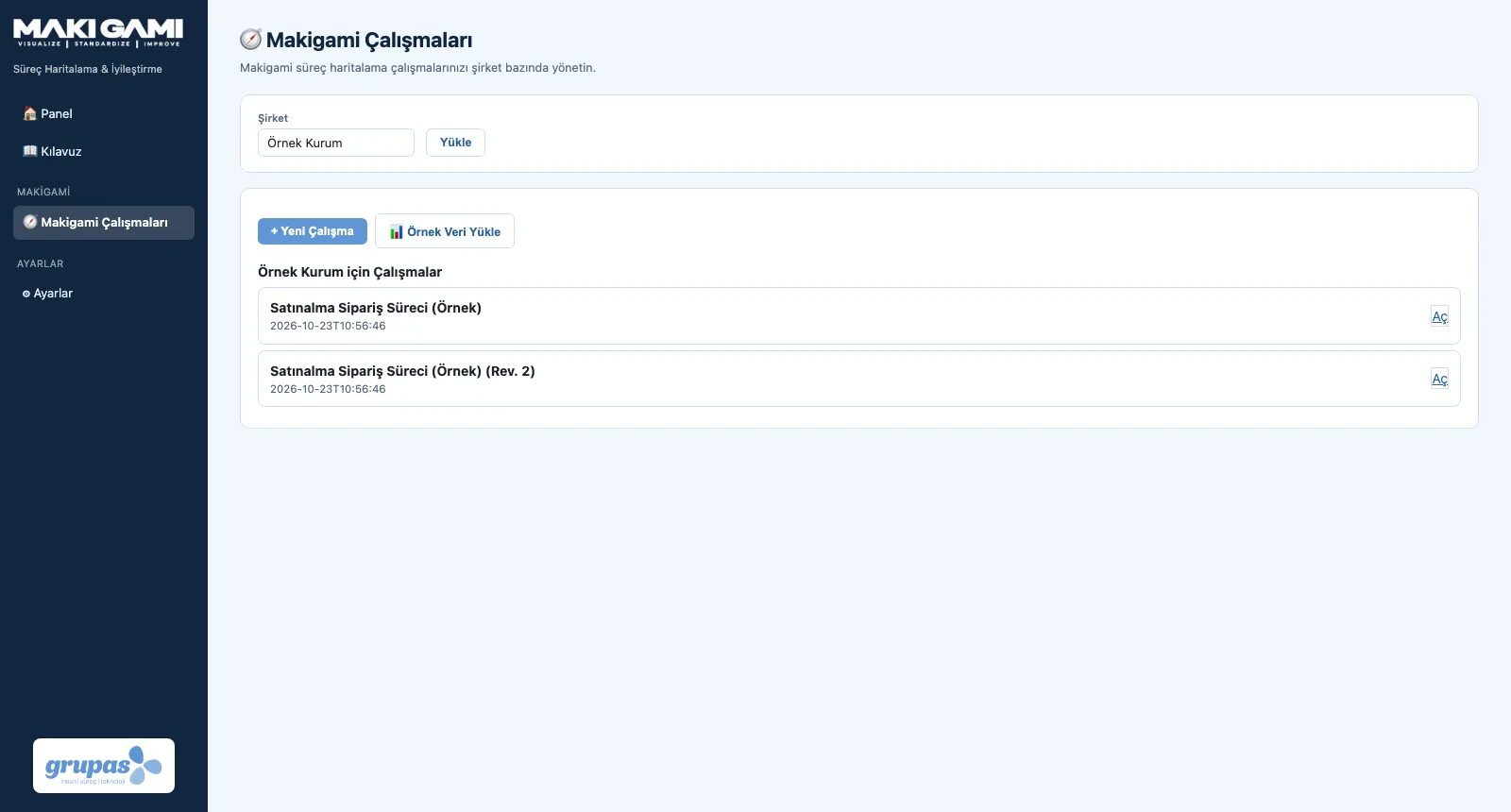
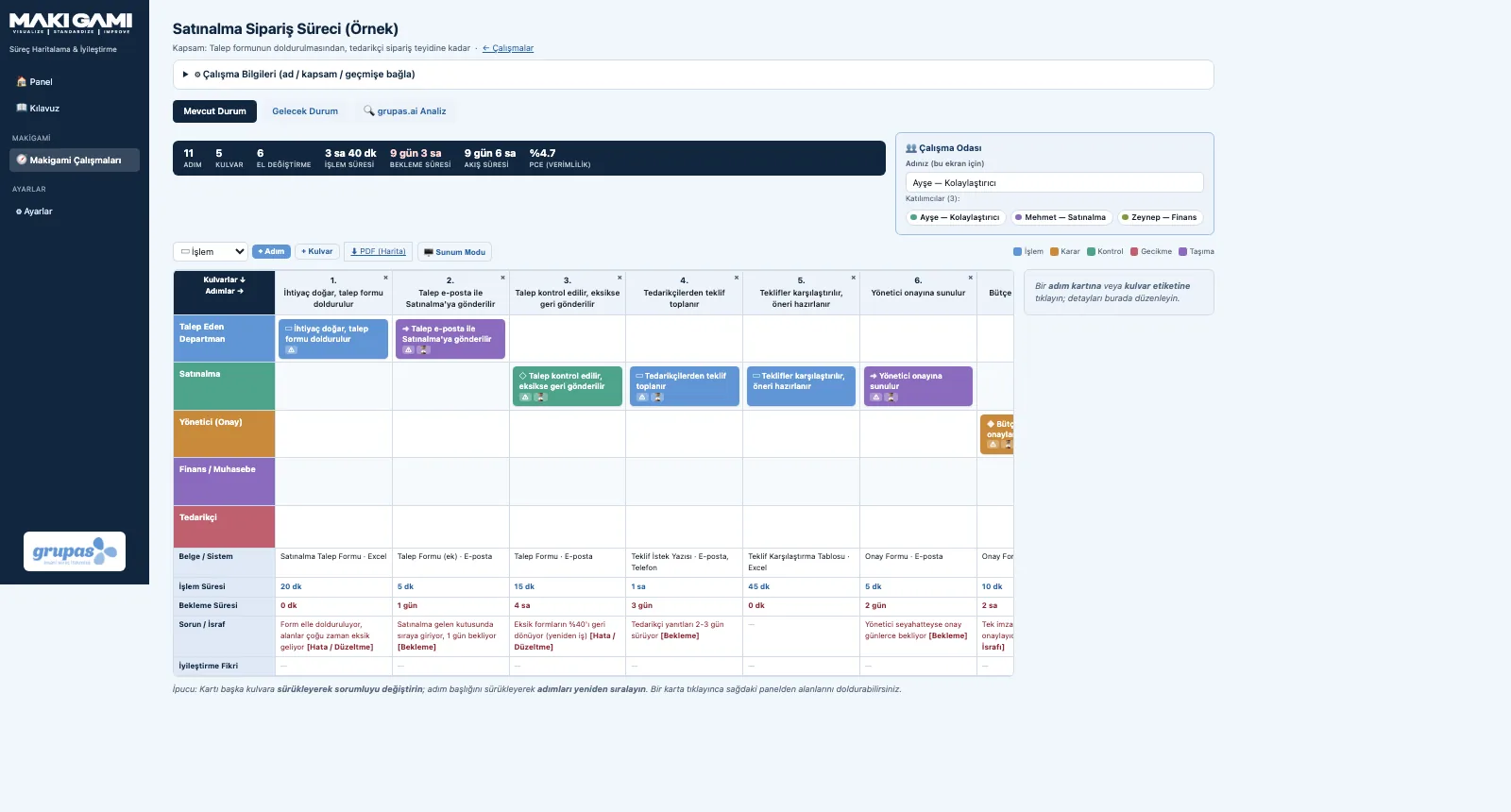
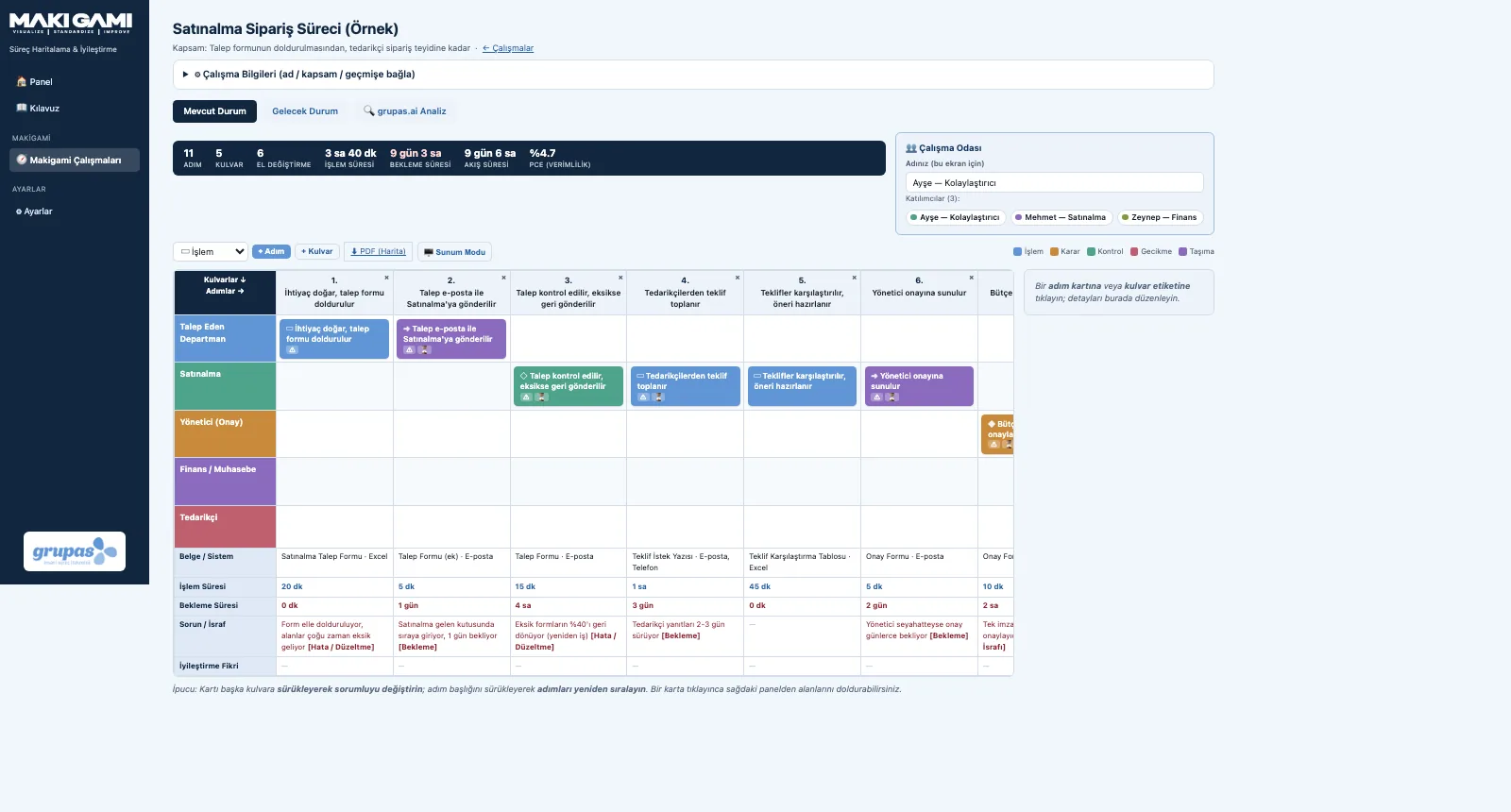
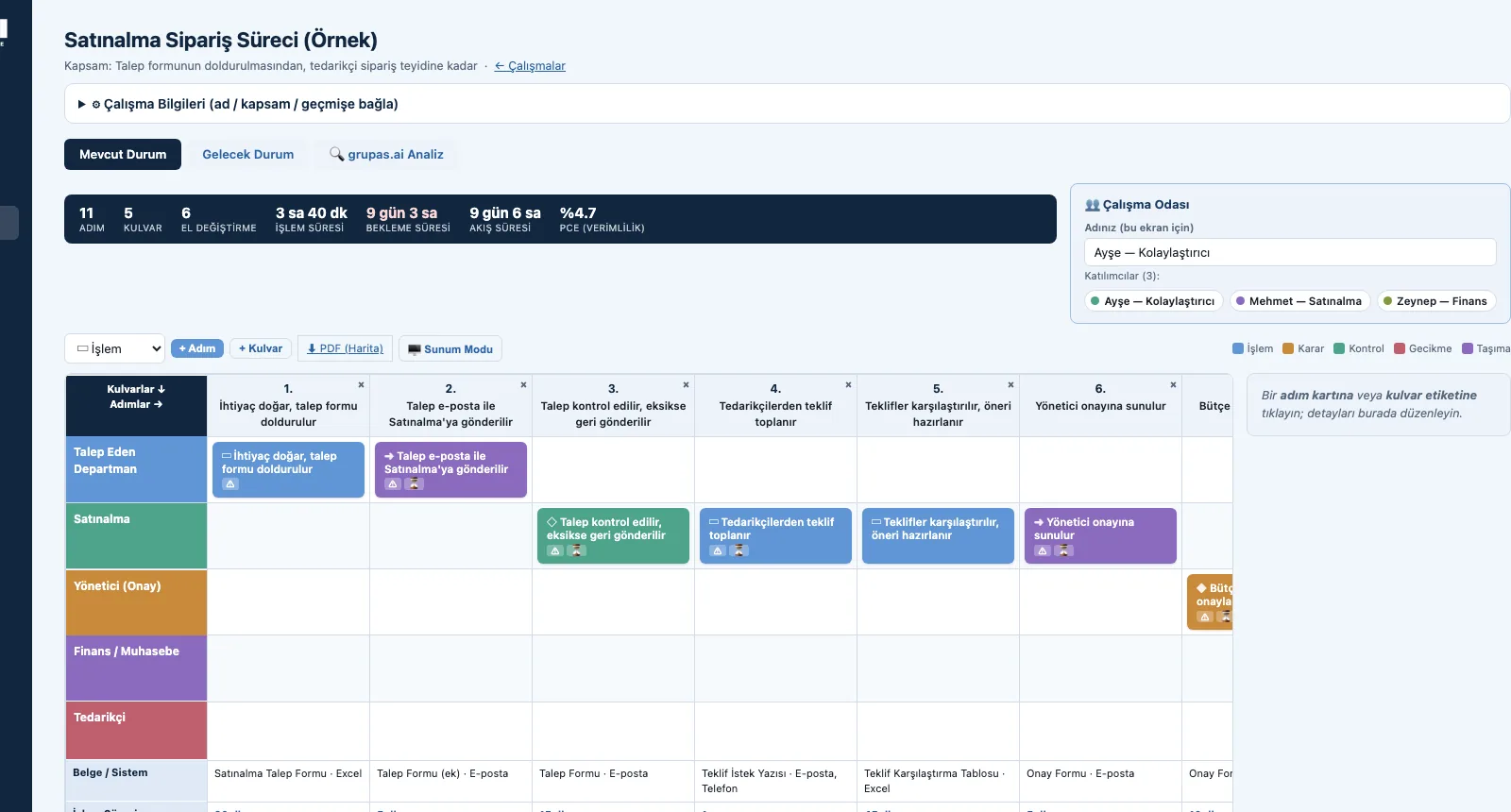
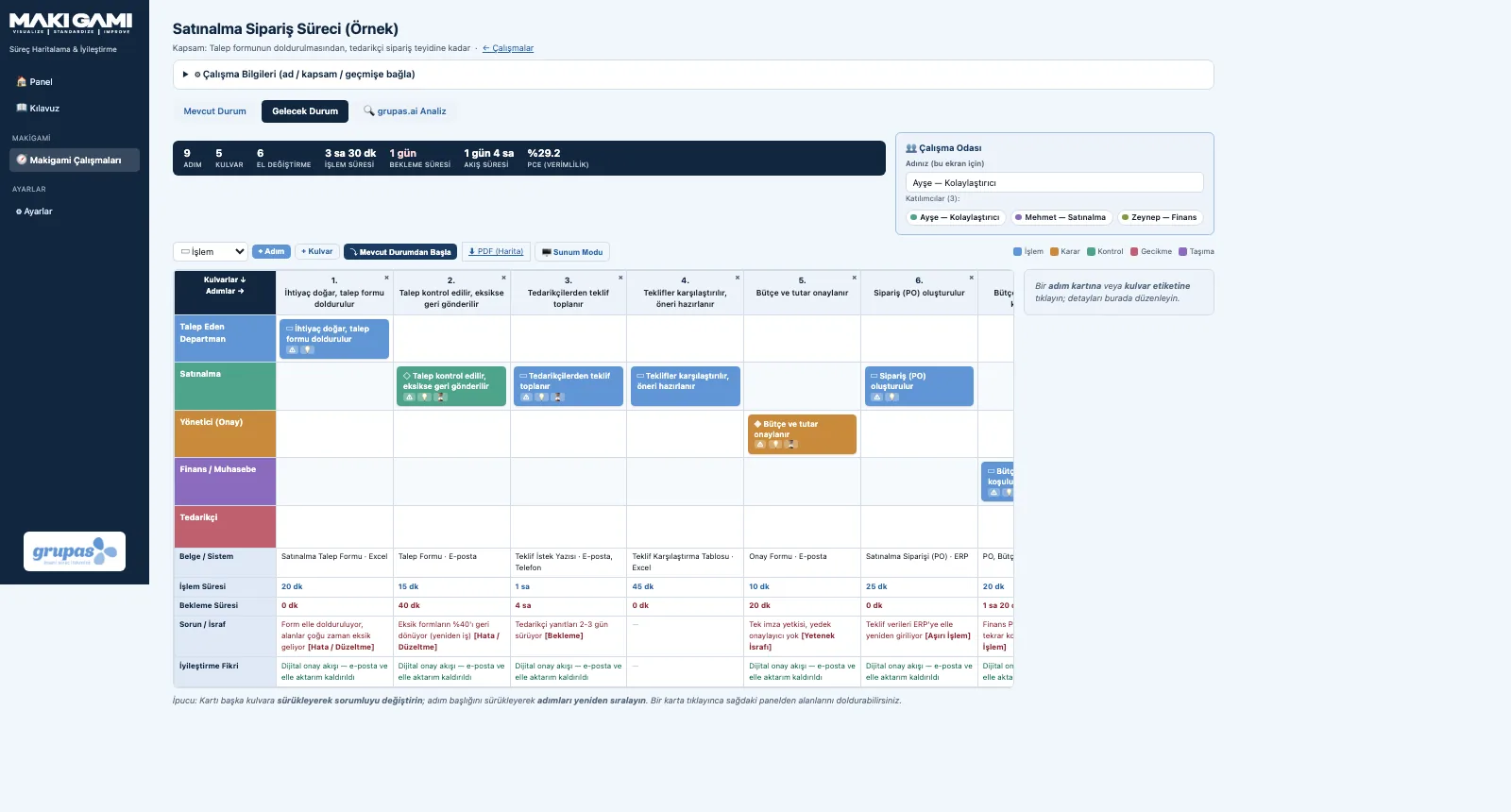
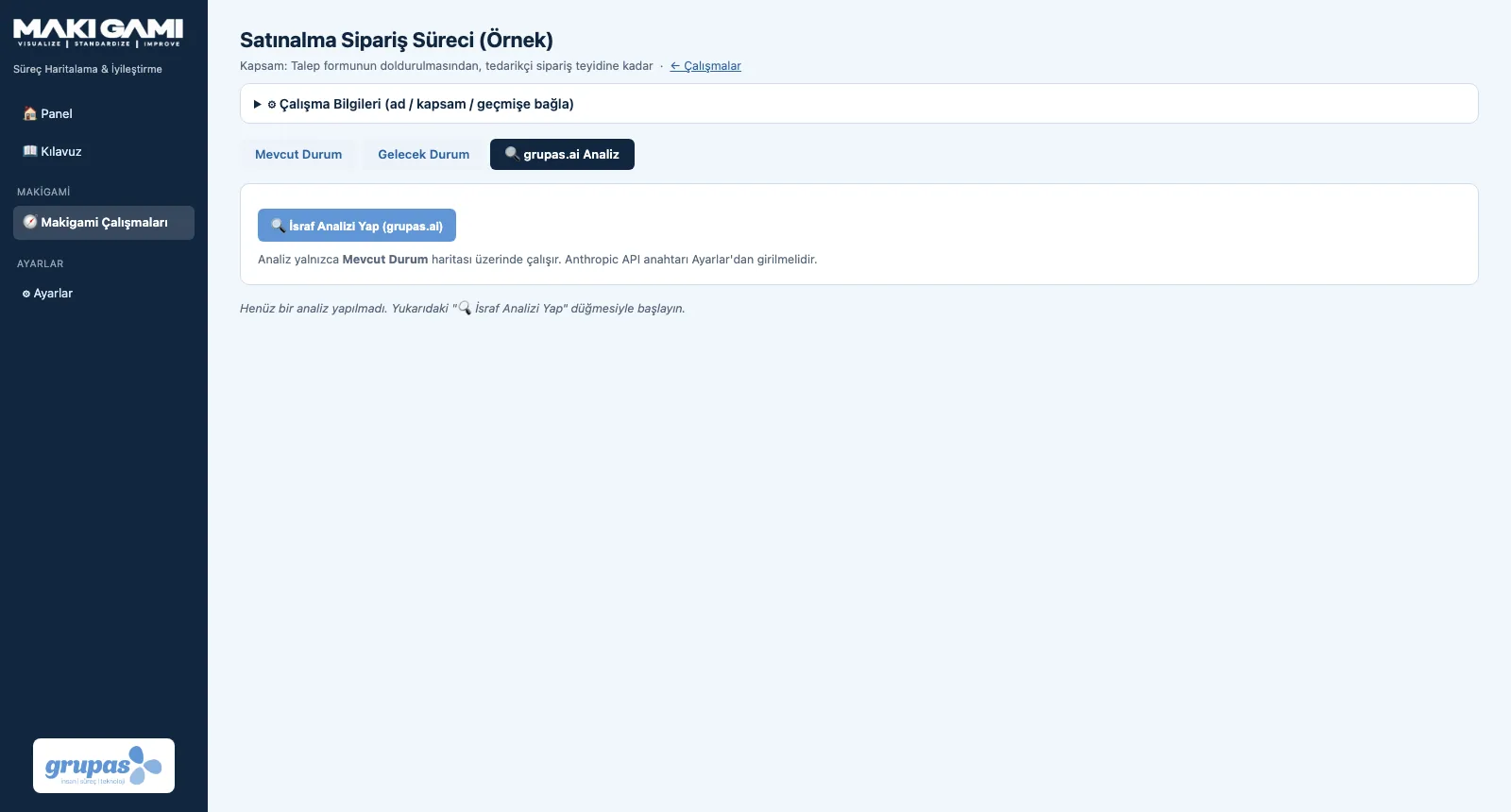
Screens are shown with sample data; the application interface is in Turkish.
What it brings your process team
Swimlane grid
Steps run left to right, actors in lanes; drag a card to change the owner, drag a header to change the order.
Analysis under every step
Document / system, processing and waiting time, problem and idea bands; problems are tagged with one of 8 office wastes.
Metrics on their own
PCE, lead time, total waiting and the number of handoffs are recalculated with every change.
The team works at the same time
Participants edit the same map from their own devices; changes reach everyone within seconds, with who changed what. Presentation Mode for the projector.
Current and future state
The future state starts with one click from a copy of the current state and is measured with the same metrics; studies are kept as revisions.
AI waste analysis
grupas.ai brings out bottlenecks, waste findings, improvement recommendations and quick wins, and suggests a PCE target.
Share-ready outputs
The map downloads as a landscape PDF with lanes, bands and metrics; the analysis report as PDF or Markdown.
Backed by training and consulting
MAKI GAMI was built on Grupas's lean office training and consulting experience. The guide explains the method, the 8 office wastes and the workshop steps; it runs in the browser with nothing to install.
For any organization with document, information and approval flows
Offices of manufacturing companies
Administrative processes that feed the plant: purchasing, order handling, planning, shipping, invoicing, quality and HR.
Service organizations and public institutions
Application, approval, document and file-heavy flows: banking, insurance, healthcare, logistics, education and municipal services.
Lean office and digital transformation
Teams, trainers and consultants who want to streamline a process before digitalizing it.
- Process owners and department managers
- Lean office, quality and operational excellence teams
- Digital transformation and business analysis teams
- Facilitators, lean trainers and consultants
One package, the license that fits you
Every feature in every license. Choose your license model and we will prepare a quote for your number of users.
Frequently asked questions
What is MAKI GAMI?+
How does Makigami differ from value stream mapping (VSM)?+
Which metrics does it calculate?+
How does the team work at the same time?+
What does the AI analysis do?+
See your office process in MAKI GAMI
Write to us for a live walkthrough on sample data.